
We hope that all of you have a wonderful Christmas with your families!
Marlin 336 Project – .35 Remington
•14 December 2013 • 9 CommentsI have a .35 Remington Marlin 336 here that will see a major facelift. I can’t call it a restoration, since even though it will look close to new when finished, it will not look factory original.

Marlin 336 awaiting a transformation.
The rifle is a 1952 Marlin 336. Marlin rifles used to look and feel slimmer and better than they do now. In the 1930s, Winchester worked hard to improve the design of the stocks for some of their fancier leverguns, like the Model 71 and 64. Marlin followed suit. While Winchester ended up with some very beautiful stock designs, Marlin stocks became fat and chunky, and the look and feel of Marlin lever actions has never regained the slim elegance of their early rifles. Marlin 336 rifles like this one come from the period in which the stock design was about as ugly as it ever got.
The wood looks like Marlin forgot to finish shaping it. The fat belly of the forend sags grotesquely below the natural lines of the rifle. The buttstock is chunky and shapeless, and has been cut short. I never liked the plastic Marlin buttplates when new, but this one is badly worn and ill fitting. The wood has the normal small dents and gouges, scratches and discolorations, but the stock is walnut and the grain is nice, if slightly plain, a lot better than later rifles that strayed from the traditional walnut.

The 1952 Marlin’s fat forend leaves me feeling slightly unsettled, like seeing someone’s beer-belly hanging out below his shirt.
The metal looks rough, with a lot of bluing wear and some rust showing. There is little actual damage to the surface of the metal, though, so it will clean up very nicely. The front sight is dinged and the brass bead is missing. The front sight ramp is ugly and angular. There is no rear sight and the rifle wears a Weaver K2.5-C3. I really like this scope and the way it is mounted on this rifle. I tend to dislike scopes on lever action rifles, but I like this setup, and it seems right for this type of rifle. This rifle will have iron sights, though, so the scope will be saved for another use.
The bore is beautiful, with Ballard rifling, and the action seems sound, though the trigger is a bit stiff and the hammer spring heavy.
What do you think we should do to this rifle to give it a better-than-new look?

Weaver K2.2-C3 scope mounted on a 1952 Marlin 336
Let us know what you think and check back for updates as the project progresses.
EDIT – Marlin Stock Time Travel
We are taking the stock back in time. The finished shape will be a nostalgic nod to a time when rifles were true works of art and stocks had graceful lines and glowing finishes. The style is reminiscent of the pistol grip stocks used on Marlin rifles in the late 19th Century. The lines are not exactly the same as those original stocks, as we had to adjust the style to fit the shape of the stock we are working with.

Bulky 1952 Marlin 336 furniture in the midst of a transformation to an 1890s style.
Edit: Do you ever look at something and think it turned out so great that you are afraid to take the next step?
That’s how I was with this stock. But I pushed forward and there is no going back now . . .
Bears leave deep tracks.

Carving on the Marlin stock with Dremel burrs.

Working on final sanding, shaping, and stippling.

Inlay applied
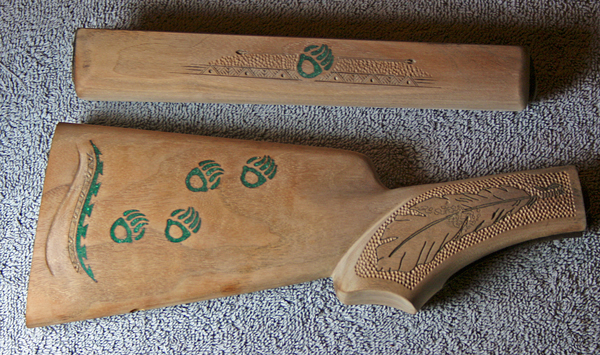
Final shaping, carving, and sanding in progress on the Marlin’s stock and forend.
Edit: Wood and metal finish

Borrowing filler screws from a Winchester 94.

Original Forearm tip tenon was cross-threaded on both sides. No one had a new one listed for 336, but Brownells does for the Glenfield 30.

New Forearm Tenon centered.

Fitting the metal to the wood. Some areas will not be a perfect fit, but the stock will fit the receiver and tangs much better now.

Blasted parts, ready for coating.
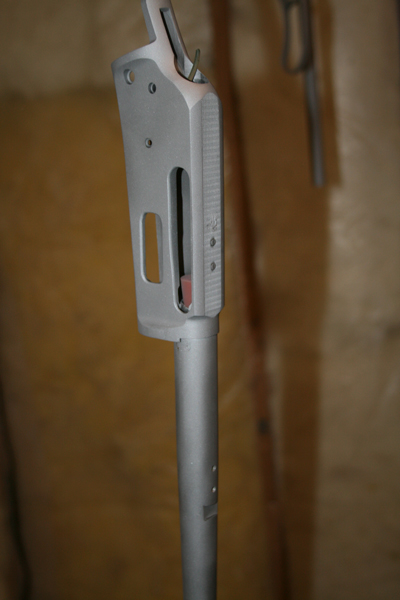
Barreled receiver prepped for coating.

Starting the oil finish on the stock and forend.

Metal parts coated.

Wolf magazine spring. At only a few dollars, I always replace these on older rifles.
Edit: Finally Assembled:


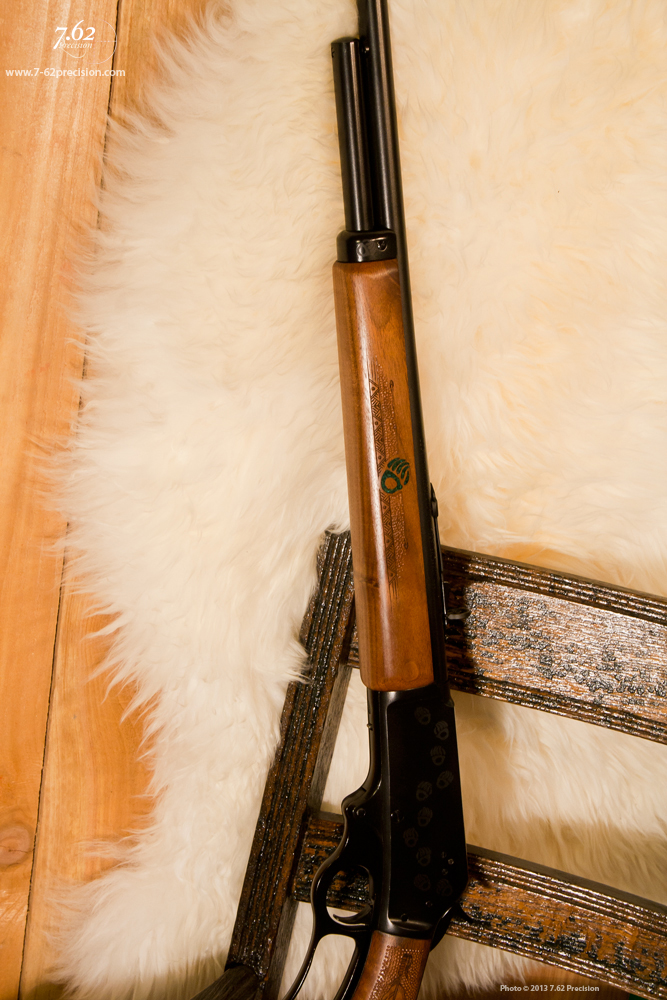
Before and After:
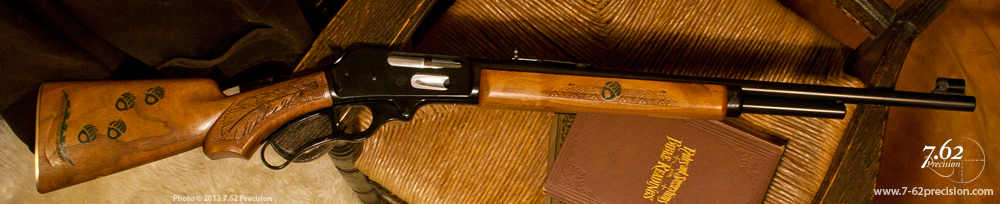
Same wood and metal, except for a few replaced parts: new sights, sight hood, forearm tenon, magazine spring, buttplate, and several screws.
The 1950s Marlin wood got a hand-rubbed tung oil finish after re-shaping.
Testing New Polymer Backup Sights
•11 November 2013 • 1 Comment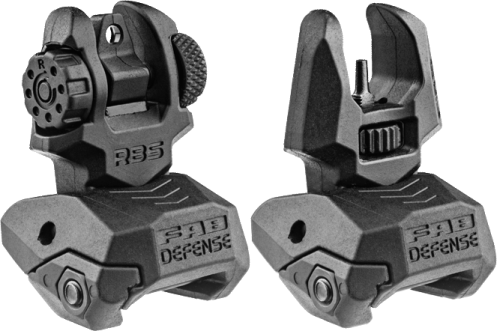
My .50 Beowulf bear defense carbine got a set of back-up sights. I had considered a lot of backup sights for this carbine, and I have some of several brands, but the sights I chose are FAB Defense RBS and FBS sights.

I first saw a prototype of the FAB Defense sights a couple of years ago, and I have been waiting for the final product to go into production. As soon as they were available, I ordered several sets to see if they lived up to the potential I saw in the prototypes.
Backup sights are important for any rifle that uses an optic of any kind. Whether found on fighting carbines carried by soldiers or fine custom bolt-action rifles used by trophy hunters, backup sights have an important purpose; to keep the gun in action even if the optic is damaged or even lost. In combat, a survival situation, or when facing dangerous animals, backup sights could keep you alive. I have heard heartbreaking stories from hunters who spent thousands of dollars on the hunt of a lifetime, only to damage or lose their scopes, ending the hunt or leaving them using an unfamiliar rifle.

When I look for a backup sight, I look for a sight that is designed for the type of rifle I will be using them on. They need to be out of the way until they are needed. I want sights that are very simple in design and operation, and I want sights that can take some abuse. Because I have a number of rifles, affordability is a consideration.
Knife Safety
•07 October 2013 • 1 CommentMy wife says I am over-obsessed with safety. I don’t think that is is a bad thing.
My dad began teaching me safety from my earliest memories. “Always wear a life jacket.” “Treat all guns as if they were loaded.” “Don’t use the axe near other people.” “Don’t walk around with an open knife.” “Don’t cut toward yourself.”
I have carried a knife continually since I was 5 years old, when I began carrying my uncle’s old cub scout knife. I have used knives for carving, building, and working on little projects as a kid. I have used them for cutting fish, for cutting meat, for cutting explosives. As a kid I cut myself occasionally at first when carving, but never very bad. Each time I learned something from the experience, and I recognized that it is better to learn from the pain of others.
I have known people who have been injured badly with knives. I have learned from their mistakes. Often, though, what we know about safety and what we do are different. Sometimes we need to be reminded that just knowing is not enough.
Sometimes, we know all the right things, but we just consider ourselves a little better, a little more skillful. Sometimes, we are just in a little to much of a hurry. Sometimes, we just go ahead using the wrong or damaged tool because, usually, we get away with it. So I learned a few things that I already knew. I learned a few that I did not. I already knew a dull knife is dangerous. I knew that rushing a cutting job is dangerous. I knew that thought should go into the direction of each cut. I already knew an animal being worked on should be held securely.
I learned that it takes a lot of force to punch a dull tip through an animal’s hide from the inside out. I learned that when the tip does break through, all of that force is released quickly and uncontrollably. I learned that a knife blade puncturing the thigh and slamming into the femur leaves you feeling like your leg got whacked with a bat.
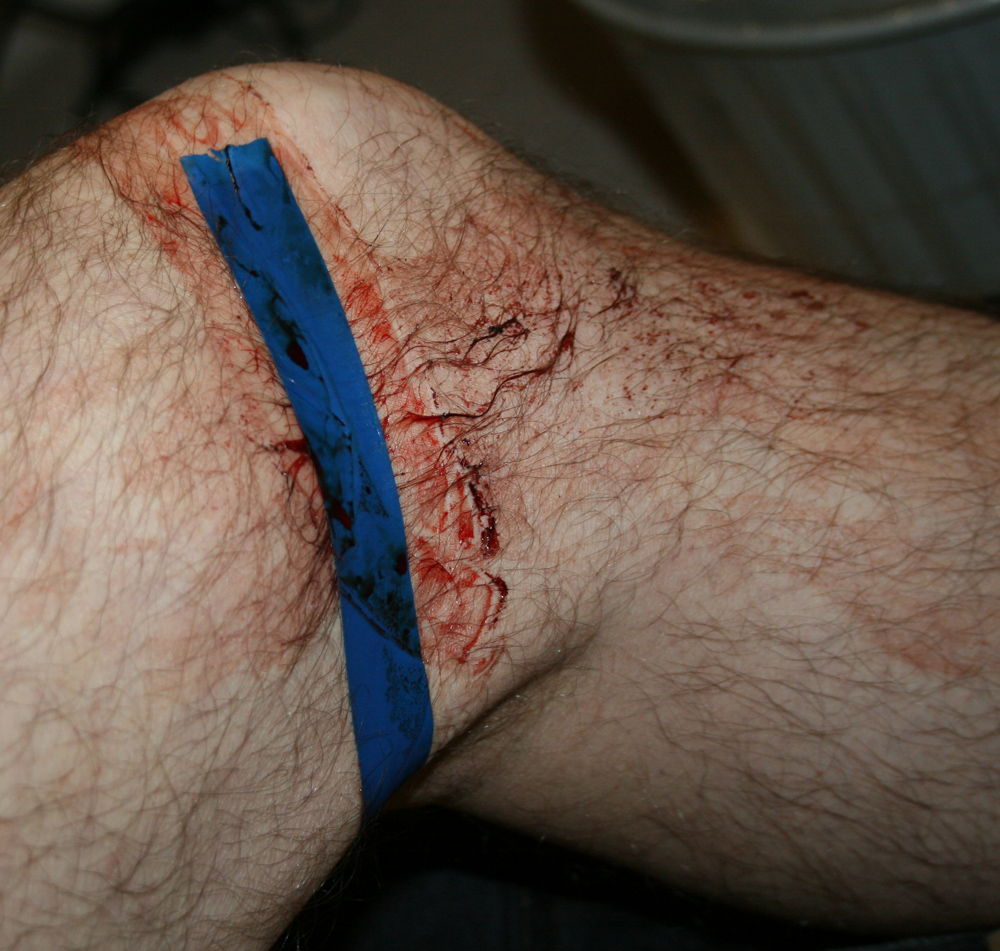
My leg during cleanup at the hospital. Notice the professional electrical tape bandage still covering most of the wound.
I had plenty of time during the steep climb down the mountain to the lake, blood running down my leg and soaking into my sock, to think about what I did wrong.
It was not one huge mistake, but a number of serious safety violations that combined to result in a serious injury. We had hunted up and down a steep face. Going up and down the dangerous climb with three small children was more exhausting than usual. Darkness was coming quickly and we still had a bit of a climb down to the skiff when we saw the wallaby. It hopped away, but turned to look back over its shoulder for a second, the last look-around it ever had.
The kids were thrilled; they wanted to take the whole wallaby home to show their younger siblings. I should have just carried it out whole, but decided to gut it first. Light was starting to get poor, so I was hurrying. The knife I had borrowed had a sharp edge, but the point had been turned and blunted on something. When I realized the tip was so dull, I should have stopped. The shape of the blade was different than i was used to and it felt awkward to me. The guts were ruptured by a bullet fragment, but not a mess yet, so I was trying to handle it in a way that would prevent making a mess of the job. I was still opening the abdominal cavity, using a type of knife that I don’t usually use, and trying to go fast to beat the dark. I was on uneven ground, and I shifted my right leg a bit for better balance, putting it closer to the wallaby. I was working near the tail and trying to push the tip of the knife through the skin from the inside, using way to much pressure. I don’t know if the wallaby moved first or if the tip punched through first, but suddenly the wallaby was sliding sideways while the knife punched through the hide and came free with the full force of my effort behind it, with no directional control at all. It stopped against the bone in my thigh. I stood and took a few steps away without saying anything, but the kids had seen it and knew what had happened. I smiled at them and told them I was fine, but I was actually slightly concerned; I was unsure of the exact location of the wound. I made them turn around and stand behind me, but as soon as the cut was exposed they came around to see and became quite alarmed. Hopefully they learned a lesson from my mistake, preventing future injuries of their own.
Mistakes I made:
• Did not bring my own knife
• Rushed the job
• Used a dull knife
• Cut in the general direction of my own body
• Working with unstable footing
• Did not bring good first aid supplies, other than a tourniquet.
The hike out, skiff ride across the lake, and drive back to town was not too bad. It could have been much worse. I could easily have severed a tendon, stuck the knife into my knee joint, or have been wearing a tourniquet (I had one with me).
I didn’t get back from the emergency room until 11:45 pm, and was headed out at 7:30 the next morning to hobble around wrestling, castrating, ear tagging, and vaccinating calves, making me painfully aware of what damage to a thigh can do for mobility, and, of course, taking an unmerciful ribbing from everyone who had heard the story by then.
I will soon post a recommendation for simple first aid supplies to be carried when hunting, working, traveling, or shooting.
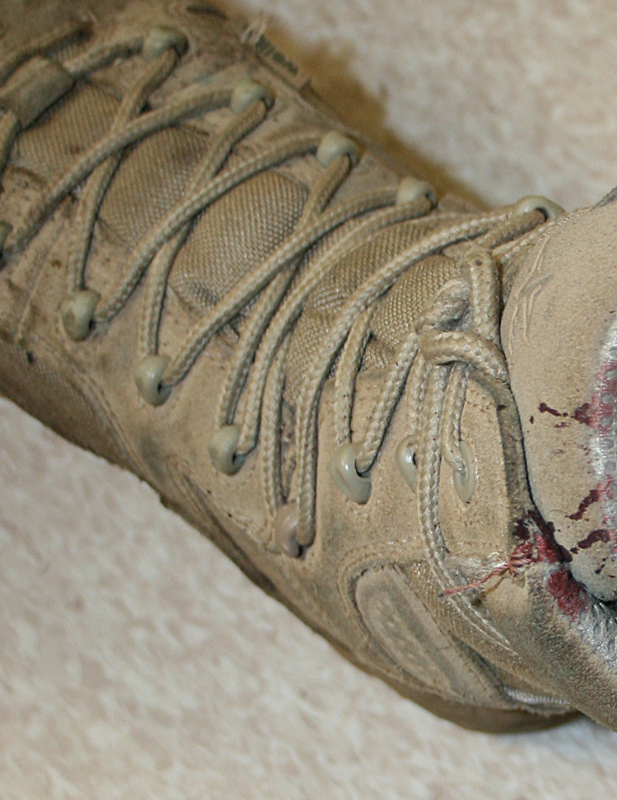
Blood on boot
Common Sense Firearms Laws – Suppressors
•29 September 2013 • Leave a CommentThere is a lot of talk these days from politicians about “common sense gun laws.” The problem is, most of these proposed laws do not involve any common sense.
Today I am writing from New Zealand, which has very restrictive gun laws. New Zealand gun laws were the laws that the Clinton era assault rifle ban was based on, and like most current proposed US legislation, are based on banning firearms by features and by looks, not by any particular logic.
Senseless gun laws are not a new thing in the US. Since 1934, sound suppressors have been restricted in the America. A sound suppressor, often erroneously called a “silencer”, is a safety device designed to protect the hearing of the shooter and bystanders. Like the muffler on a car, it reduces noise to a level which does not permanently damage hearing.
Most countries promote the use of suppressors on firearms. Some European countries offer incentives to encourage shooters to use them. Most of these countries have far more restrictive gun laws than the United States does, but their governments recognize the benefits of such a useful safety device. New Zealanders, who look the the US as one of the last citadels of firearms freedom, are astounded that suppressors are restricted in America.

Hunting wallabies in New Zealand with a suppressed .223 rifle. Suppressors are considered important safety devices even in countries that heavily restrict firearms ownership.
I just returned from a hunt in very heavy brush. There were no open areas and it was so thick that it was rare when I could see more than 75 meters. In fact, I saw number of stags 50 meters or closer that I could not shoot because there was no clear shot through the foliage. I was even closer to a many wallabies that I was unable to shoot. In these conditions, listening is everything, as in almost every case, the game was located by sound before it could be seen. If we had been wearing hearing protection, hunting would have been even more difficult.
At the end of the day, we walked out with a young red stag and a number of wallabies. After shooting many shots with a .223 and a .308 with no hearing protection, our ears were not ringing. Suppressors on both rifles, inexpensive and unrestricted in New Zealand, saved our hearing from being damaged.
Suppressors quiet shooting ranges, keeping noise levels lower for those on the range and for those who live near ranges. Some ranges in Europe stipulate that suppressors must be used out of respect for their neighbors. Suppressors protect hearing. Hearing loss is a huge problem, and a major healthcare expense. While most responsible shooters use hearing protection on the range, it is sometimes inadequate for certain firearms, and few hunter use hearing protection while hunting. Every shot a hunter is exposed to without or with inadequate hearing protection causes irreparable damage to hearing.
I always use hearing protection when shooting on the range. I almost always use hearing protection when hunting, too. Even so, I am often around firearms that too loud for the hearing protection I am using. Certain hunting cartridges create heavy recoil, leading hunters to install very loud muzzle brakes. These brakes, designed to reduce recoil to manageable levels, also often increase the sound of the shot to unreasonable levels. A sound suppressor not only reduces the noise, but also reduces recoil. In fact, the concussion of the muzzle blast from some .50 caliber target rifles with large muzzle brakes has been found to cause brain injury after a high volume of shooting. I will no longer shoot those rifles without a suppressor.
President Theodore Roosevelt fitted one of his 1894 Winchester hunting rifles with a suppressor out of respect for his neighbors. In this way he could target shoot and control pests without disturbing those who lived nearby.

Young Red Stag harvested with a suppressed rifle. Suppressors in New Zealand cost as little as $200 each, save thousands in healthcare costs for hearing loss, and do not contribute to any increase in crime.
So why is America one of the only places in the world where sound suppressors are restricted? It makes no more sense today than banning mufflers on cars. President Theodore Roosevelt fitted one of his 1894 Winchester hunting rifles with a suppressor out of respect for his neighbors. In this way he could target shoot and control pests without disturbing those who lived nearby.
Long ago in America, commercial hunting was widespread. Even after laws were passed curtailing it, commercial hunters shot waterfowl and deer for sale to restaurants and some grocery stores. During the depression, many people who were looking for a source of income turned to commercial poaching. At a time when people were heavily hunting for food, this additional pressure of poaching for commercial sale threatened wildlife populations. Many commercial poachers used quit .22 caliber rifles to avoid detection by wildlife enforcement officers. A few of these commercial poachers had rifles fitted with suppressors. In a misguided attempt to prevent commercial poaching, suppressors were restricted by federal law, and several states enacted their own laws as well. Of course, this had no effect on commercial poaching, and only the end of the depression and restricting the commercial sale of wild game made a difference.
Restricting suppressors, of course, has no effect on crime. Suppressors require precision work to be done to the host firearm, and add cost. Many criminal prefer inexpensive, simple firearms. Any criminal who was willing to go through the effort could have a suppressor illegally, since they are simple to construct, and can be installed on a firearm by anyone with the right tools and knowledge. The fact that they are not used in crimes shows that removing restriction on ownership will also have no effect on crime.
So now we are left with one of the most ridiculous restrictions on firearms; a restriction on a safety device. If we need some common sense firearms laws, how about protecting our hearing and removing the restrictions on sound suppressors?
At the end of the day, we walked out with a young red stag and a number of wallabies. After shooting many shots with a .223 and a .308 with no hearing protection, our ears were not ringing.
Interesting Buttplate
•04 July 2013 • Leave a CommentI stumbled across this photo of Col. Townsend Whelen’s buttplate from his 1895 Winchester. I’m halfway tempted to replicate it on my .35 Whelen 1895. It would seem fitting, somehow.

The buttplate from Colonel Townsend Whelen’s 1895 Winchester.
The dream rifle . . . and suddenly, there it was.
•24 June 2013 • 3 CommentsAnyone who has spent much time with me has heard about a rifle I was going to have some day. It’s a rifle I’ve had in mind for many years, but it is not available commercially, and the base rifle to build it from is on the expensive side.
I have always loved Winchester lever actions. When I was a small child, my father’s Winchester Model 71 kept us in fresh meat (there were no stores or any way to ship perishables into our village). Friends’ fathers had Winchester 1895s, and no one I knew who had one was ever in a hurry to get rid of it. My dad almost bought an 1895 in .303 for me when I was nine, but it was in rough shape and I chose a beautiful little Model 70 featherweight carbine in .243 instead.
Later, when I did get an 1895 Winchester, I learned why no one ever wanted to part withone. While I would gladly own any ’95 Winchester in any of the factory calibers, my heart was set on a union between John Browning’s sleek rifle and Col. Townsend Whelen’s creation.
The .35 Whelen is one of those cartridges that just seems right. It seems sepecially right for the ’95 Winchester, which has never been factory-chambered in that caliber. This means that a .35 Whelen 1895 Winchester is a re-barrel or rebore proposition.
So my plan was to get a .30-06 1895 rifle and rebarrel it to .35 Whelen. To do this I had three options for the base rifle; and original 1895 (pre-1940s) in .30-06 or .30-03, a 1980s Browning re-run in .30-06, or a current Winchester re-run in .30-06 or .270 Win. I quickly ruled out the idea of using an original rifle. The steels used in the early 1900s were not as strong as the steels used today, and many of those old .30-06 rifles have fired a lot of rounds, possibly heavy loads, for many, many years. Above all else, though, I do not like the idea of messing with a piece of history. My preference was to try to avoid the current Winchester production as well. I have a current Winchester 1895 saddle ring carbine in .30-40 Krag; a beautifully built rifle that shoots like a dream, but the tang safety and rebounding hammer are an annoyance to me. That left me looking for one of the 6,000 standard-grade .30-06 rifles built under the Browning name in the 1980s.
Occasionally I would check the auction sites and local gun stores for an affordable rifle, and sometimes I would see one for a really good price – just when I couldn’t afford it. Over the years I have watched the price of those Browning 1895s steadily increase. I kept checking, planning to snag one eventually, shoot it in .30-06 until I could afford a barrel, then shoot it in .30-06 until I could afford to have the barrel installed.
So a couple weeks ago, I was sort of skimming over the auction sights again, without really any money to spend, and suddenly, there it was. On Gunbroker was a nice looking Browning 1895 – already chambered in .35 Whelen!
Of course, I could not afford it.
There it was sitting at $675 for days on end and I could not afford it.
My wife, however, was insistent, so when the auction ended at just over $800, she was on the phone with the seller, debit card in hand.
 The rifle arrived last Friday and I was surprised by it’s condition. My initial assumption was that the the description was slightly inflated, but the photos were deceptive and the rifle was basically like new; better than described. The original barrel has been rebored and re-crowned and the original caliber marking has been neatly removed and replaced with a very clean, professional “.35 Whelen” marking. The bore is a mirror. There is no sign that the rifle has been fired since the re-bore, so at the most it has only had a few shots through it and a thorough cleaning of the action and bore. The first five or six times I cycled the action put more wear on the lever and mag body where the lever rides than was on the rifle when I took it out of the box. Finish on the stock is beautiful.
From looking at the rifling, my guess is that it will shoot great. If not, I still paid less than I am seeing .30-06 rifles go for, so I am no further behind if I have to rebarrel it. I expect this one will shoot fine.
The Browning rifle is built the same way as the originals (but not to exact dimensions), so the action and trigger are noticeably nicer than the current Winchester rifles with their rebounding hammers and extra parts. It has the current style forend, which I do not like, so I will probably do some reshaping eventually to mimic the originals. I considered replacement wood of a fancier grade, but this is a rifle that will be used extensively, so it might be a waste. The buttplate is a thin, flat, slick-faced, sharp-cornered little beast that seems to be eyeing my shoulder maliciously. Bony guy that I am, I should install a recoil pad. I have a checkered shotgun-style buttplate that I ordered as a Model 71 buttplate, but it turned out to be too narrow. It is the right size for the 1895. The purist in me leans toward the steel buttplate, but my practical side is pushing for a buttpad. Tough decisions.
The rear sight dovetail has a filler blank in it, and there is a Williams receiver sight mounted. It looks way too modern. The sight is in new condition and has no marks on it, so I will pull it off and sell it to partially fund a Lyman type 21 style sight. The originals are quite expensive and better suited for an original rifle, so I will go with the Providence Tool Company reproduction. I have one on my 1886 Winchester and it is a great sight.
One of the local shops had one box of Remington .35 Whelen ammo on their otherwise empty shelves, so I will be taking it out to see how it shoots while I wait for some better ammo to get here.
I’ll let you know how it shoots.

1895 Winchester rifle marketed by Browning in 1984. Rebored from .30-06 to .35 Whelen.

Browning 1895 Rifle in .35 Whelen.
Busy times
•24 June 2013 • 2 CommentsWe have been flat out busy for the last few months and are still trying to get caught up on everything as the buying panic slows down. For 7.62 precision, the buying panic did not really bring an increase in sales, as we did not have large quantities of items that people were really panicked about, though we do have a large supply of magazines and a small stock of AR parts now. Most of these were obtained in order to supply somer of our best local customers at normal pricing, though.
What the panic did do was drastically increase our call and email volume, and a new type of customer – a nasty, bullying kind of customer that takes a lot of our time.
We have been behind on getting quote requests turned around, and I have not posted anything new to this site is some time. Focus has been dealing with customers and getting holsters and stuff shipped out as quickly as usual. I will try to post some of the finish photos from the last year as I have time.
 7.62 Precision Custom Firearm Finishes